A NATIONAL CONFERENCE
ON
‘ENTREPRENEURSHIP AND BUSINESS DEVELOPMENT IN INDIA
: ISSUES AND CASES’
(4 - 5 November, 2011)
Organised by
KOUSALI INSTITUTE OF MANAGEMENT STUDIES (KIMS)
KARNATAK UNIVERSITY, DHARWAD
KARNATAKA, INDIA.
About Karnatak University, Dharwad (KUD):
Karnatak University was established in 1949 to cater to the higher education needs of people of this region. It is spread over a vast area of 750 acres and has its own ambience with a sylvan setting of undulating greenery. The second oldest in the state, the University has 48 P.G. Departments, 3 PG Centres, 5 constituent colleges, 528 affiliated colleges; 264 PG and 4252 UG teachers; and 4531 PG and 1,01,142 UG students. Various traditional and need-based courses are offered to prepare the students for facing the larger challenges of life. The University is rated as a university with potential for excellence and has been accredited with ‘A’ grade by NAAC.
About Kousali Institute of Management Studies (KIMS):
The Department was established in 1976. The institution blossomed into one of the best ten institutions in management in the country during that period. Presently, the MBA programme is rated to be the best amongst all the universities in Karnataka. KIMS has got a strong alumni network who has occupied positions in many top–notch companies both within the country and abroad. KIMS has developed a special niche for itself in the field of imparting quality management education. The students of KIMS are trained to a perfect blend of current industry knowledge and skills of modern management.
About Dharwad City
Dharwad is a beautiful town of almost 200000 residents in the North West part of Karnataka, India. The history of Dharwad can be traced back to 12th century. It is just east of magnificent "Western Ghats". Dharwad is surrounded of hills and there are numerous lakes and other smaller water bodies. Dharwad is quiet and peaceful city amidst lot of vegetation. It has made many people's dreams come true through its educational institutions and generous people, who have always supported poorer students. Students come here from all over North Karnataka. The twin cities of Hubli-Dharwad are located at a distance of around 420 KM north of Bangalore and 550 KM south of Mumbai. The city of Dharwad is just east of the famous Western Ghats and is surrounded by hills and lakes and is a prominent educational centre with three Universities, two engineering and two medical colleges.
How to Reach Dharwad:
Dharwad is one of the major cities on the Mumbai - Bangalore railway line and on the Pune - Bangalore National Highway (NH-4). The Airport at Hubli is 18 KM from the Venue. The other nearby airports are Belgaum (80 KM), Goa (160 KM), Bangalore (420 KM) and Mumbai (550 KM).
From each of the above cities, there are numerous luxury buses and trains. Kingfisher flies one daily flight (Bangalore-Hubli-Mumbai and back), the departure of which is 7.30 from Bangalore and 16.30 from Mumbai. Hubli is recognised as a head office of South-Western Railways and is one of the major railway junctions in Karnataka. There are regular trains to Hubli-Dharwad connected from Bangalore, Vasco/Goa, Pune/Mumbai, Ahmadabad, Chennai, Hyderabad, Howrah/Kolkata and New Delhi.
Patrons of the Conference:
Chief Patron:
Prof. H. B. Walikar M.A, Ph. D.
Conference Chair and Organising Secretary:
Prof. M. S. Subhas IIT-M, IIM-A, Ph.D.
Advisory Committee:
Prof. S. B. Hinchigeri M.Sc. Ph.D.
Prof. C. G. H. Khan M.A, Ph. D.
Prof. A. H. Chachadi M.B.A, Ph. D.
Prof. S. S. Hugar M.Com, Ph. D.
Prof. L. D. Vaikunte M.A, Ph. D.
Prof. Shivappa, MBA
Prof. N. Maruti Rao, M.Com, Ph.D
Prof. N. Ramanjaneyalu, M.Com, MBA, Ph.D
Overview of the Conference:
"Most of what you hear about entrepreneurship is all wrong, it’s not magic, it's not mysterious, and it has nothing to do with genes. It's a discipline, and like any discipline, it can be learned", says Peter F. Drucker, The Father of Modern Management. This quote by The Father of Modern Management, stresses on the point that entrepreneurs can be made easily by proper training and it’s not bizarre that entrepreneurship not associated with Genetics of a person to be an Entrepreneur. Instead, it can be taught to a person that how to be a successful entrepreneur and what things can lead him to reach his entrepreneurial objectives. Further, started business needs to follow the right phases to find its objectives coming true only by developing the business thus started.
This Conference on Entrepreneurship and Business Development (EBD) makes an attempt to discuss on the above theme in broad with special reference to India. The Conference is scheduled to be conducted during 4 - 5 November, 2011. This gives an opportunity for all the intellectuals from Academics as well as from the Industries and agencies like Governmental and Non-governmental Organisations (NGOs) those especially involved in EDPs – Entrepreneurship Development Programs, to explore and expose themselves to the world of Entrepreneurship Development and its related issues.
Call for Papers:
The original Research papers, articles and case studies are invited on the main theme and other sub-themes; those would be under going through the double blind review from the experts. Abstracts as per the guidelines need to be sent to the Conference mail-id on or before 25th August, 2011 by mail. Acceptance of the abstracts would be confirmed to the authors by 30th August, 2011 via e-mail. For more details on dates, kindly go through important dates. Selected papers in full text would be published in the proceedings of the conference, in the form of a peer reviewed edited book consisting of ISBN number.
The sub-themes chosen for deliberation in the Conference are:
Entrepreneurship Development in India
Entrepreneurship Development Program (EDP)
Women Empowerment through EDP
Role of Governmental interface in Entrepreneurship Development in India
Rural Enterprises
Business Developmental stages and Model(s)
Role of Market Orientation in Business Development
Issues relating to Marketing, Finance and Human Resource in the process of Business Development
Role of services like Micro-finance, Venture Financing and Consultancy in the process of Business Development
Value Enhancement for Business Development
Guidelines for Authors:
The authors must mention the subject line as ‘Paper/article for EBD Conference-2011’.
The acceptable file formats for the word processing documents are “Word for Windows 1997-2003 document”
Manuscripts must be double spaced, with 1-inch margins with “Times New Roman, Font Size 12, black”
All tables, charts, graphs, diagrams, and images should be black and not in colour. The scanned images taken from various sources should be redrawn in black and white format (and not pasted as they are).
References and citations should be complete in all respects and arranged in alphabetical order as below:
Text references should appear as follows: Recent works from (xxxx, 2005, yyyy, 2006) show...
Journal references should be listed as follows: Kohli, A. K., Jaworski, B. J. (1990), ''Market Orientation: The construct, Research Propositions and Managerial Implications'', Journal of Marketing, Vol. 54, April, 1-18.
Books should be referred as follows: - V. Venkata Raman, G. Somayajulu (2005),"Customer Relationship”, New Delhi: Tata McGraw Hill Publishing Company Limited.
The final draft is subject to editorial amendments to suit the requirements of the proceedings of the Conference. An electronic version of the manuscript in MS- Word would be required once the paper is accepted for publication.
Important Dates:
Submission of Abstracts 25 August 2011
Communication for Acceptance of Abstracts 30 August 2011
Submission of Final Paper 25 September 2011
Communication for Acceptance of Final Paper 30 September 2011
Registration 05 October 2011
Registration Details:
Registration/Delegate Fees:
Amount (Rs.)
Participants (General) 1500.00
Participants from Academics 1000.00
Participants (From Affiliated Institutions of KUD) 750.00
Research Scholars and Students 500.00
Spouse/ accompanying persons 250.00
For registration remit registration fees in the form of DD drawn in favour of ‘The Director, Kousali Institute of Management Studies’, payable at Dharwad and sent along with the Registration form to: Dr. M S Subhas, Organizing Secretary, EBD National Conference, Kousali Institute of Management Studies (KIMS), Karnatak University, Dharwad – 580003.
The last date to submit the registration form and delegate fee is 5th October, 2011. Spot registration will be strictly discouraged. The above charges are of excluding lodging; however participants would be assisted in making suitable arrangements on demand.
Contact Details:
Send your registration form duly filled in along with the prescribed DD to:
Dr. M. S. Subhas
Organising Secretary,
EBD National Conference,
Kousali Institute of Management Studies, Karnatak University,
Dharwad.-580003, Karnataka State
Phones: 0836-2741882/84
Mobile: 09844065681
Fax: 0836-2741882
Email: nationalconferenceatkims@gmail.com
Web: www.kud.ac.in
NATIONAL LEVEL CONFERENCE ON ‘ENTREPRENEURSHIP AND BUSINESS DEVELOPMENT IN INDIA: ISSUES AND CASES’
KIMS, KU, Dharwad, Karnataka
November 4-5, 2011
REGISTRATION FORM
NAME: Prof./Dr./Mr./Mrs./Ms. ___________________________________________________________ (Last Name) (First Name)
If you need a participation certificate, please write exactly how you would like us to print your name:
____________________________________________________________________ (Use CAPITAL Letters)
If you are presenting a paper, please indicate Abstract Reference Number of the Paper(s)
1. ___________ 2. ____________ (max 2 presentations by one person, sorry!)
Would you like to chair a technical session? YES NO
ORGANIZATION/UNIVERSITY: _________________________________________________
Postal Address:____________________________________________________________________
______________________________________________________________________________
______________________________________________________________________________
Phone::______________________________ Mobile: ___________________________________
E-mail: _________________________________________________________________________
Alternate E-mail: _______________________________________________________________
REGISTRATION FEE SCHEDULE:
Amount (Rs.)
Participants (General) 1500.00
Participants from Academics 1000.00
Participants (From Affiliated Institutions of KUD) 750.00
Research Scholars and Students 500.00
Spouse/ accompanying persons 250.00
TOTAL AMOUNT ENCLOSED Rs. _______
DD Number: ____________________________________
Signature: ________________________________ Date: _______________________
The completed registration form along with registration fees in the form of DD drawn in favour of ‘The Director, Kousali Institute of Management Studies’, payable at Dharwad and sent along with the Registration form to: Dr. M S Subhas, Organizing Secretary, EBD National Conference, Kousali Institute of Management Studies, Karnatak University, Dharwad – 580003. Thanks.
The last date to submit the registration form and delegate fee is 5th October, 2011. Spot registration will be strictly discouraged. The above charges are of excluding lodging; however participants would be assisted in making suitable arrangements on demand.
Website: http://www.kud.ac.in/ E-mail: nationalconferenceatkims@gmail.com
Monday, August 1, 2011

Friday, March 4, 2011
Visit to Solapur and surrounding field areas including Naladurg and Tulajapur on training of Entrepreneurs on MOVE approach to develop businesses
A training Session in collaboration with Swayam Shikshan Prayog (SSP)
(01-03-2011 to 02-03-2011)
Day- 1: 10:00 am.
Discussion with Balasaheb, founder member of SSP. Looks after the Solapur Dist., and mainly with Arogya Sakhi during travel from Solapur to Naladurg:
- Pvt. Kohlapur Dairy Milk: Khadhar – Deshmukh – Rs. 27 to 32 per litre.
- Govt. Milk Federation: Dhoodh Pandari – Deshmukh Gaun.
- Pots with tap in black and red were sold. – Dr. MSS, Suggested
- Blacksmiths were found to be there in the Solapur.
- Sakhi – Arogya Sakhi – Health Scheme. – 30000 per year to cover –Cashless bases per group 5 members. – 7500per annaam – Oriental Insurance with Swastya India (NGO)- Settlements and client dealings. – 4 Years. First was as Arogya India. 8000 families benefited. 500 people have already taken benefit – 20,00,000 collection. 65,00,000 premium being collected. They do have a OPD, wherein this card is made available to make use. Only new patients needs to be there – usually old deasesa is not been dealt.
- NREGA – There is no clear information about where to go and benefit by the Scheme. Hence finally even those people have come to our Health Scheme. But we don’t cover major diseases like TB, Cancer and HIV-AIDS. They go to Dist. Hospitals.
- Today’s session – Importance of Marketing/survey. – SSP has to look at the things which could sell by its own and for that its recommended to have a kind of survey – PMA. By this you can contact both the sellers and manufacturers, by which you can have a mutual benefits and also you can club all your other Schemes/offers. By PMA you can get to which product/service to produce and sell and also on which to concentrate more.. SSP
- Our health Scheme we convey the schemes and ways of health, trained by HP KIT, charges 5 per beneficiaries.
- Mahila Vidya Parishet – 3 moths training on diseases and curing, first aid, etc. Swast India provides the tables/Medicines needed.
- No salary to the volunteers but there is a payment for each membership forms. Regading fro pregnant women still things are on and about to come out with some 6 diseases. Nothing with Diabeties and even BP. Swasthya India is the aiding and training Agent for the Arogya Sakhi Scheme. There is a huge demand to look after the diseases Diabetics which has 40 % of patients of the diseases.
- Sakhi Retail Pvt. Ltd. (SRPL)– Oorja, Solar Lamp, Cang Cang (Pharmacy), Powder for Increasing the milk yield, Purit, Godrej water filter, Mobile(Handset), Laptop, Mr. Upamanya Patil, CEO os Sakhi Retail decides on the materials to be sold under the SR. Yes, Products to be as per the demand from the buyers. Oorja sells more – 1050 per piece – pallet is moe of demand – its the No. 1 product, Rs.40per 5 KG that goes on for about 20 days, they mainly use fro heating the water and for cooking the food. Wood is available even on free basis, na dits the main key aspect of this. This of more demand in Rainy season.
- Poultry – No much in this area, may be due to Bird flu. – Presently they get it from nearby city.
- Nothing is aaible for testing the water, instead we have for testing the Age and Pregnancy.
- No present any Income fro the Swastya Sakhi, they are earned by forms only. They get nearly 2000 per month. Swasthya India is with a Kit, and deals with things to be dealt in the area. There are 3-4 people to look after the project, they have their own Pharmacy at every Dist places. 30% is for the project from the Doctors under the Scheme.
- About 3000 is being spent by each family on the health issues. About 100 is being charged by the Doctor for the consulting and rest is fro the medicine prescribed. This expense goes up in the months of Rainy Season – Managing with Water is the main source of all the disease.
Session on PMA @ Naladurg: 11:00am
- Profile: Here are some 20 entrepreneurs of about 7-8 years of experience. Textiles, Papad, Flowering, Leasing the land for farming,
- Introduced and Welcomed by the Flower and a welcoming song, by Mrs. Leela Tai – In presence of Lakshmikanth. Eatery Game is over and they enjoyed it, go it know how to divide the bigger quantity into micro quantum-micro sales.
- Sanjeevani Mali Tai – Khad Village – had 7 days MOVE training along with other 10 people., she felt a difference between the normal/traditional and after MOVE way of doing business – Dhai Business, she got to know what to do and how to change the business, got to know about pricing, packaging, and marketing, about the location about the stall, % profile, expenditure and earnings. It turned us to have accountability and to take the products to the known market. They do have a Organic Banana Selling.
- Kalpana – Vada Pav, Papad(Urd), - by training go to know about business regarding sourcing of the RM, and was able to join hands with the Men even in the task of Marketing/Selling.
- Nirmala – Neelegaon – About business, we
- Bhale roa – Khad Village – Vegitable Business (Methi, Beans, Peas, Groundnut, MoomaPhalli) – she started by having a land on lease by knowing the chance of converting into a manufacture – 8000 per 5 months (50% of sales from the production to the owner of the land and the rest to the entrepreneur). In the initially she had with the lesser amount and now she is able to grow 30-32 bags of Wheat kind of grains from about 2.5 Acres, - plans for adding about 3 Acres of more land into the project.
- Farzana – NalaDurg (Repeated Batch from Khad Village) – got know how to get to the contact of the market and about the pricing – how about installing the M/c, and other chances of going onto Value Enhancement, presently with Milking business – Rs. 20 per Litre. Bit ambitious to go for developing the business and mainly looking for the
- Madhubhai – Kirana Store (Self) – for the rest of the family members got started with other business like Tailoring, Computer, Cycle on rent
- DoulatBhi – Flower Mala – Garland making and Selling, for special and common occasions, in addition I have a buffalo as an alternative income source – she was guided by a scientist to startup a feed preparation work by which she can feed her own buffalo as well as she can even sell the same to other, this could become as one more chance of business.
- Ammenabhi – Papad – it runs for 8 months, for the rest 4months no work so has got a buffalo as an alternative. She has employed for 4 other women. She also things on the opportunity cost of leaving the forest/farming labour work and getting into the business. She plans for extending for the future.
- Lakshmikanth – (Story)- Raja in urgency comes and pickup the Horse with an information that, if turned left ear to it could fly early, and he did the same soon after knowing this. But he was left out with the rest information and did not know how to come down, this lead him into the trouble. This kind of imperfect learning and knowledge would leave anyone on the way without reaching the expected Destiny. Thus, it is suggested not to think more on the credit in the first instance than knowing a clear picture about the market and business knowledge/plan, credit is not the only factor.
Talk by Dr.MSS: I’m here to guide you for the development of your business, which we usually do for the bigger giants in the business sector. Main things to remember –
1. Find out the needs and wants of the customers – Customer Knowledge.
a. Find out the feasibility of the business and mind that there is no chance for loss, at least reach out the BEP.
b. If there is no customer there would be no existence of the business. Many a times, it happens that we forget the customer expending on various things during the different occasion like marriages, find out the kind of the marriage and find out the ways to match the nature and his/her need at that instance.
c. Try to customise your product as per the kind of the customer, also be clear in understanding the customer in the right way. – It is essential to understand the customer, and also be confirmed about the need of extra services to him/customer, and be confirmed about reaching the right customer and should not target the all the others who wouldn’t necessarily be your customer.
2. Be affirmed of profitability and accountability of the business. Learn to practice about getting the knowledge of profitability and any chances of fetching more out of your customer. Try to keep a track on each customer visiting you and don’t waste your resources on those who aren’t your customer.
3. Try to know the effects of each transactions being done with the customer and try to identify the chances of more profitability, also try to find out the best chances of reducing the cost (May be like health problem and losing other resources – added by Lakshmikanthji) and maximising the earnings (also think on the future aspects – added by Leelathai)
4. Have a knowledge of profitability compared to expenses on the business, keep a track on each steps and find out the most important (Critical) step by concentrating on which we would get the most profits out of it and which is the step contributing loss to our business and what’s the means by which we could get rid of it or by pass the step.
PMA – Questionnaire preparation:
1. Papad
2. Flowering
3. Dairy/Milking
4. Vegetable Selling
- Find out who our customer is, where he/she is from and where he/she stay. This will certainly reduce uncertainty and rescue you from getting into loss. This is even necessary for bigger companies too.
- PMA questionnaire is also a affordable for illiterates
o Know the buying behaviour of your customer
o Nature of purchase – quality and quantity
o Frequency of purchase
- Village map – get to know the % of customers going out of village for the purchases and to whom can we trap easily and convert them into be our potential customers
- Flowering as services for the customers – Decorating work
- Try to skim the cream from the customer if he is potential and ready/willing to pay.
- If you get to know your customer – then you can have better negotiation with him/her
- You can get a clues on value enhancement
- Make an estimation of about level of your potential business
- Decide o whether to go ahead with the business or not, affirmed with suitable profitability
- PMA to be extended to Sakhi Retail (SRPL).
- PRA and Village map represents the market conditions
- Mobile + Services – Recharge, Repair, and Replacements, can be further extended to DTH-Services, recharging and other billpayments
Session after Lunch break: 2:45 pm
Group – Flowering
- Why did you collect this data
o To know customers and associated details
- Why is the extremities in the prices
o Because of lowest and highest rates as per the may be seasonal
- Can you now mention the data of whole village (Sales)
o Women gave some approximate data as per her own estimations without any supporting data – this why there is need for a survey
- On coming out with huge data (about 4000 Households), Can someone start a new venture with the existing
o Women said, existing itself is doing well and Yes, others also can start
- Can a new entrant do business successfully
o Yes, depends on CRM and the way he/she does it.
Group – Dairy
- Kindly divide the households into 3-classes as may be like Rich, Medium and Poor
- Divide the demand/purchases on classwise
- Similarly try to estimate the demand for different types of milk products – milk, curd, butter, ghee, panner, etc..
- Then by comparing demand v/s supply decide on starting a new venture(S)
Group – Vegetable Selling
- What do you feel after (PMA-Sample survey) doing this
o Buying pattern of the customers and whether to do business or not
o Whether there is a chance to be a profitable business or not
Group – Papad
- How about dividing of the village as a whole
o Not yet done, but it differs from households to hotels
o May about 400 papads per day
Summarisation and conclusion:
- Come out with the reasons to start a business also, how and why you want to start
- After calculating demand for entire village, try to cater to at least 10% of it.
- Then come out with the strategies to double your sales if you have already begun some business
- If you are with the milk selling, you need to extend your business by at least 25% by diversifying your business like, milk to curd, ghee, panneer, etc.
- Calculate and compare about expenses and profits in your concerned business like flower selling
- Regarding Papad, estimate about how much we could sell to households and hotels
- Find out the reasons behind why does and doesn’t customer go to some specific sellers
- First think on your own business, later think on economies of scale
Additions by Leela Thai:
- Learning business is also like schooling, needs a continuous and in depth learning for successful business – many things are there to learn like, 4Ps, CRM, Quality concerns, etc.
Covered and closing of the session by Jayashree Thai.
Day 2: 9:30 am
Discussion with Rajesh, member of SSP. Looks after the Solapur Dist., and mainly with Microfinance, during travel from Solapur to Tulajapur:
- SSP looking for the inputs for entrepreneurs from Dr. MSS
- Willingness to pay and ability – essential for services (Especially Health) – need to buy them in affordable way.
- Accidental Entrepreneurs – this is the major part in the usual system – this has to be made them has to be well trained and successful
- (Profile/self introduced by Dr.MSS)
- MOVE – if anybody wants to setup an enterprise first know your market, not essentially skills part, and NGOs involved should be trained in this ways because they are main people involved in EDPs
- Identifying is the major issue to start any enterprise. By PMA they will be self understanding and self sustainable otherwise they would depend and NGOs to sell for them.
- Push entrepreneurs should be the real entrepreneurs - these are scared of uncertainness of market – fear of failure, uncertain future – Market and fear of failure of failure are both interrelated, rural people can’t come out with out of box think to facilitate the survival and here NGOs has to come for the need, - family based entrepreneurs were thus more market oriented due to more familiarising along with their bringing up. If you ignore the market the market will leave you. Changing of business is possible if you are well known/familiar with the market, finance wouldn’t be the problem to start, Banks also even looks for this kind of market assured proposals/plans. Right kind of motivation is essential to promote ED, specially they look for the security part, age is another aspect – so, young people has to be forced to be entrepreneurs. Women have many roles to play and right kind of support is essential towards this, she has a good amount of persistency and this has to be rightly made used. – you should also include the youth during the e-school, because later there would be someone to support and take ahead-like her son or daughter. Confirmation has to be done so that they would feel as a guaranteed job to be with, like doctor, teacher or so. – Entrepreneurs on role is the required Call on this, if not for a long time create or run for short term and sell it off to others – this also requires NGOs to support with some reserve funds – or else NGOs can make them to start, be with them and also during the selloff, like Holding your NGO ruled and Woman owned Enterprise, and let there be changing or ownership but ensure the running of the business, at least in terms of training pattern to the fresh or budding Entrepreneurs – similar like outsourcing/franchising.
- Intrapreneur – to – Extraprenure (Something like entrepreneurs turning to be good employee) – employees to setup an enterprise
- Many a times people with EDPs and PMA survey are most of leaving NGO and coming out of their Enterprises – Similar case happened during a training @ Mangalore, recalled Dr. MSS..
Meeting with SSP representatives @ Tulajapur: 10:30 am,
{Between Dr.MSS and Upamanyu with his team (Rajesh, Lakshmikanth and Leelathai), along with R B Hiremath and Vijayakumar}
SSP – has added a new product – Aqua Tab (Water purifier)
New project – 250 entrepreneurs as output – one year. – This would be the target of the e-schools, involves a project and Village fairs (3000 No.s – 50 vilages-50x60) for the women, later even we would fund them (10-20)
- leadership seminar (Rs.100 – 2000 target to filter it to 250), Motivation (2000 target) and entrepreneurship counselling (Rs.1000 – 600 for training {25x10 or 30x8} and 600 for counselling)
- intensive training is essential than the gaps.
- Trial and error things may lose the trainees (feedback and continuous following is essential)
- Ex. of Kolkata, was of one month, they were confirmed and guaranteed to set of business soon after business, trainer has got the crucial part in ending up with the support and starting the businesses, Hence intense training is must, @ Kolkata had started thing like Tiffin Dabbas and they did well by starting the same.
- If we get the existing entrepreneurs for the training, make her to have enhancement in her business.
- Training is essential for the councillors (10) at least for 2-3days, and these people have to be made associate from the beginning right from Village fair.
- Crucial thing is to have conversions from seminar to training – Rs. 100 to 2000.
- May be there is no need for going to follow the more prolonged process, instead direct enrolment for direct training would work out more effectively.
- Hence 1000 seminar to 250 training.
- First two processes, village fair and seminar should workout as trailers for the forth coming trainings in the future.
- Entrepreneurs are lonely, he has to be taught to lead himself without any others support.
- Counsellor can be linked with the No. of targets set and his remuneration can be linked with the performance of the businesses thus started because of him.
- Need to select the bigger villages to be safer side for ensuring the No.s.
- Women being selected should have at least a son to take for the future, so that with the help of extending some services to him also we can trap his mother – women.
- Schemes like education to the women as trainees!
- The sons of those women should be made included in the training.
- Hence Age(<35)>
- Training of Counsellors at least for two days is a must.
- Identify the 5-6 model kind of typical business for all the areas to help out for training and focusing of Counsellors.
- Counsellors should be bounded with the contracts for about a year.
- In normal case existing he is being paid 3000 per month, this can be added with business start-ups and value enhancement in the business
- Counsellors are looking after supporting towards holding a counsellors working and funding is a part of A&Z, we got it through Sahita (Mrs. Renuka)
- Entrepreneurs on role – employee completely responsible for starting and running a business, even can sell back the business entity. – This would safe guard them from the uncertainty and be ensured of a fixed monthly salary.
Wednesday, January 12, 2011
Brief MOVE Methodology:
The first module begins with basic team building exercises and motivational games. The next module asks participants to create imaginary production companies and compete. Participants also attempt retailing by setting up a hypothetical grocery shop. They also experience the running of a service business through the eatery game. Next, participants are taken on format-free (FFMV) and formatted market visits (FMV) to observe the dynamics of different types of shops and the sales of different products. In a format free market visit trainees behave as customers and tend to negotiate prices. But in the formatted market visit, through informal interviews with business owners, participants obtain details on profit margins, daily sales, seasonal sales, wholesale prices, and other strategies for selling different products. Armed with this information, the group short lists five or six products or services for collecting further information. Products are then analyzed in terms of 4Ps ; Product, Price, Place, Promotion, and Distribution strategies; while Services are analyzed in terms of the 4 Ps above as well as Physical evidence, People and Process.
After this analysis the group is ready to use a new innovative tool called the Participatory Market Appraisal (PMA). Like Participatory Rural Appraisal, PMA uses the same method of employing visual symbols so illiterate participants can conduct empirical market research themselves. The PMA allows the participants to estimate the total size of their market, the amount of potential profit, the key factors that influence a customer buying the product/service, and other relevant data that will help them decide between businesses. By doing the research through the PMA, participants enter business with their eyes wide open to the potential scope and profitability of selling certain products/services. The key difference is that the PMA provides a grassroots approach to market research. At every point, participants themselves are the ones who collect information from the market, prioritize potential products/services to research, design, conduct, and analyze the results of the PMA. By using the PMA process participants’ capacities are built to research the market themselves whenever necessary without relying on the expertise of an outside agency. After researching which product/service has the highest chance of success in their market, participants begin retailing or small scale production, branding, packaging, sample selling, and gradual up-scaling. After a few sales cycles they conduct customer feedback sessions and adjust their products accordingly. As they develop a customer base, they continue to solicit feedback to find out potential avenues for value enhancement. Finally, participants draw up a business plan that incorporates a vision for future expansion. After they capture the market through sample sales, only then do they go on scale.
Wednesday, November 4, 2009
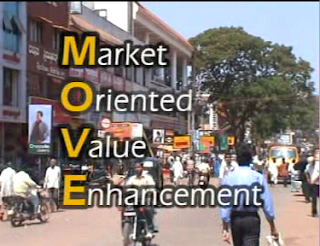
MOVE - Market Oriented Value Enhancement
Market Oriented Value Enhancement (MOVE) is a method to approach income generating activities for the landless, asset-poor, and illiterate with marketing as the central focus.
The development of the MOVE training programme was funded by the UK Department for international Development, as part of a research project to study natural resource management and poverty alleviation in villages near to urban areas. The five villages involved in MOVE were Channapur, Gabbur, Kotur, Mandihal and Mugad, and the urban area was Hubli-Dharwad, Karnataka.
Marketing, for our purpose, is defined as understanding the customer’s needs and wants, and designing and delivering products and services accordingly.
Market Orientation is when instead of being oriented to their perceived abilities or lack of it, participants will undertake a business venture according to customer demand. The key to the process is when participants first ask, ‘What does the customer want?’ and then, ‘How do I deliver it?’
Value Enhancement is the process of continuously evolving new products and services to cater to customer needs and demand. By adding value to products according to the customers’ wants, entrepreneurs can serve specific market niches that larger producers cannot cater to.
Market Oriented Value Enhancement (MOVE) is a method to approach income generating activities for the landless, asset-poor, and illiterate with marketing as the central focus.
The development of the MOVE training programme was funded by the UK Department for international Development, as part of a research project to study natural resource management and poverty alleviation in villages near to urban areas. The five villages involved in MOVE were Channapur, Gabbur, Kotur, Mandihal and Mugad, and the urban area was Hubli-Dharwad, Karnataka.
Marketing, for our purpose, is defined as understanding the customer’s needs and wants, and designing and delivering products and services accordingly.
Market Orientation is when instead of being oriented to their perceived abilities or lack of it, participants will undertake a business venture according to customer demand. The key to the process is when participants first ask, ‘What does the customer want?’ and then, ‘How do I deliver it?’
Value Enhancement is the process of continuously evolving new products and services to cater to customer needs and demand. By adding value to products according to the customers’ wants, entrepreneurs can serve specific market niches that larger producers cannot cater to.
A copy of Acknowledgment Letter from

à MOVE/ PMA
Although customer survey (PMA) is a great tool. There are some problems with it. For example achar (pickle), the entrepreneur surveyed all 10% of her villagers. They all told her how much achar they make and the types they eat. However, in the village no one has ever buys achar. Everyone makes it yearly. The survey assumes that each customer surveyed will buy achar from the entrepreneur. In order to minimize the risk, this entrepreneur needs to find other markets where they can sell achar.
Some of the entrepreneurs seemed to have adjusted the numbers to make their future businesses look more profitable. I think this has to do with the fact that they think we are giving them money to create a business. If the business was going to be created by their own money, we would probably get different results.
Some entrepreneurs need to take into consideration that some businesses are seasonal. For example, producing wheat sev (vermilli) is a seasonal thing. Not everyone buys vermilli 12 months out of the year. Even if they do eat it 12 months out of the year, they only get it produced seasonally.
Some of the customers have seemed to given wrong answers. This is something that is very common to Sauhrastran culture. People here like to mislead each other. The extent of jealousy is very strong within caste and clans. They might give the entrepreneur a really outrageous answer or a really low answer, depending on how much they like them.
My biggest job in the next few weeks is going to be how to revise and change PMA to fit it to our environment.
- - Thank you Mr.Rushi Sanathra
A Discussion on MOVE - Training:
Why Women’s Livelihoods have have failed?
In a globalized marketplace, it is almost impossible for rural producers to match the prices and economies of scale that huge multi-national producers can offer. Micro-enterprise programmes ask the poor to invest time, capital, learn how to manufacture a specific product and then leave them to struggle to actually sell it. Most of them fail because the emphasis has been on skills training to produce a particular product and they had no understanding of the market. The producers don’t move with the changing customer’s needs and wants. Conventional training does not address these issues leaving the women without the ability to sustain in the changing market. Large scale industries may be able to produce more at a cheaper price, but the small-scale micro-enterprises can provide doorstep delivery, customized products, and meet other specific needs in ways that huge producers simply cannot. Entrepreneurs should examine the scope of the market first and then activities should be decided upon based on demand. There is a need to orient women entrepreneurs to focus on the customer’s wants to be able to cope with the changing markets.
How Can This Situation Be Changed?
As part of the DFID funded project, “Natural Resource Management and Livelihood Enhancement in the Peri-Urban: Hubli-Dharwad,” Dr. M.S. Subhas of Kousali Institute of Management Studies (KIMS) of Karnatak University at Dharwar adapted a set of modules called Market Oriented Value Enhancement (MOVE), designed to teach illiterate, landless, rural women how to understand the markets. MOVE was created for well-established SHGs to orient themselves to the market, research the market themselves, choose activities based on their research, and finally to enter the market as entrepreneurs. It a tool to identify ever-more specific market niches and provides value-added services that the big players simply cannot provide.
Objectives of MOVE
- Changing livelihood training of women from product and skills oriented to markets and customer oriented.
- To help poor women evolve a sustainable niche in the market through value addition
What is MOVE?
The modules go though various processes such as team building exercises and motivational games, market visits and so on. The Participatory Market Appraisal (PMA) is where women create visual surveys to understand the total size of their market, the amount of potential profit, the key factors (product and performance attributes) that influence a customer buying the product, and other relevant data that will point to a product with a high demand and a high profit. By using the process of PMA the participants capacities are built to research the market themselves whenever necessary without relying on the expertise of an outside source. After researching which product has the highest chance of success in their market, the participants begin retailing or small scale production, sample selling, and gradual upscaling. After a few sales cycles they conduct in-depth customer feedback sessions and adjust their products accordingly. As they develop a customer base, they continue to solicit feedback to find out potential avenues for value enhancement. Finally, the participants draw up a business plan that incorporates a vision for future expansion. Thus far, every group has seen an immediate return of profits to their businesses.
Potential of MOVE
MOVE is a bottom-up strategy for micro-enterprises to approach the markets that could potentially be complemented by top-down strategies that utilize sophisticated market expertise. MOVE can be applied in many other contexts. Veterinary services, health services, natural resource based products, and many other enterprises can be approached using these techniques for market education. In addition, specific strategies for rural participants to study and penetrate urban or even international markets can be developed.
Some Feedbacks from Fellows of DCSE, Hubli on the Topic:
Market Oriented Value Enhancement:
Krishna Nayak Mrs. Meera conducted the session on MOVE marketing which I really enjoyed.She gave us an insight of why SHG's and NGO's fail. She said it's because they know how to produce, they have all the skills required, but they have no clue on where he/she can sell this products.The market knowledge is almost nil. She was quoted saying "Business start with analyzing the Market". It is a customer oriented market. A person, who does not analyze the market, does not look at the customer's specification is sure to fail.The learning from today's session is "Understand the market and Move with it".
Anita Hiremath It is an informative session with Mrs Meera and her colleagues in MOVE marketing. The concepts of MOVE marketing are really helpful for the most of the places. The main objective of this concept is to create livelihood activities for those who have lost their jobs because of urbanization. This concept is practiced in the Peri-urban area of Dharwad town. The activities were simple and meaning full. Preparation of Greeting cards, eatery game helped us to understand the basic things which we need to concentrate before entering into the market. Participatory Market Appraisal and analysis through floral diagram were good. Totally Market Oriented Value Enhancement was an enjoyable session.
Anindita Deb Roy I agree with you both. The tools for market survey were really very simple and easy to understand. As I plan to work with women SHGs in future these tools will help me guide them better and understand the market so that we can make more profit.
Shivkanya Bhujbal This module is very useful for me and got the information about marketing. We played one game in class that is preparation of greeting cards and we prepared cards without study the market and then when we went to sale our product in market at that time we realized that consumer and costumer are not satisfy our product. Here I come to known before producing goods we have to study market as well as customer’s feedback.
In move marketing I learned about how to convince the people. Explained about product like it is healthy food, special think is that it not available in market so on…… It is one of the great experiences through” learning by doing”
Sunil Patil This module made me understand the problem and challenges of Sales people And 7 P's which were helpful for us as a budding entrepreneur.
Madhu Sudhan We had MOVE marketing on 03-05-20 and 04-05-10.Mrs.Meera and her colleagues took the sessions. In this two day I learned what the status of market is and how we convince the people, so it was very difficult to sell the products. I enjoyed the eatery game and preparation of Greeting cards, this activities helps to know the market status and needs of the customer. After this game we had analysis through flower diagram. Then I learned PMA (Participatory Market Appraisal).So it was very helpful session for become a entrepreneurs.
Krishna Nayak My perspectives have totally changed now. The eatery game specially made me think what all it takes to be a seller. It’s not an easy job. We were always thinking from the Customer's point of view. In the eatery game we realized how important it is to study the market requirement, and the needs of the customer on then can a business sustain and scale up. Mrs meera quoted "Understand and produce" .Since we were in the shoes of the seller we learn't how important it is to plan, and how team work and co ordination between the team makes a huge impact on the business.
We were the second highest team who got 92% profit in the eatery game. I would congratulate my team mates Dhanalaxmi, Vishwanath, and HR for putting all those extra efforts and making this possible. Nothing is impossible in this world unless you try.
Santosh S Padatare Padatare This module is very easy. Before start this module I thought this is very tough but I was wrong. I did 4 year marketing but yesterday's game was different, it's help to understood me about gross level business.
Laxmi Rasalkar MOVE marketing session is a nice session, Because in that session i leaned about market , When i start my own business i used that strategy because than only i understand when i do a customer survey than only i understand a customer need and what they want, which type of customer, I goat a field knowledge it's very nice really i enjoyed that.
Shalini Shalini Gl This MOVE module we lot of learned faced the problems and what are the faced challenges and how to we convinced the people, so it was very difficult sold the products. These are all learned and very enjoyed the game good experienced.
Satish Madar Mrs Meera has taken MOVE marketing class. MOVE model I gone to very well. This modal i learn and developed the marketing skill also and in this modal first we have doing a one game in ready to greeting and sold the greeting but this not sold Because this greeting we have producing that much customer quality That’s why it has not sold learn this game product as a quality or continuity is main important. After then we are 5 members doing an eatery game. It has good experience for us. This game has marketing game and we did ready to senga holigi and also sold hostel. We had got a 260 income for us and we learnt how to motivate the people and what the seller problems are and how to make the profit. Then after second day I learnt new thing we were searing eating experience Participatory ensures Appraiser and Market Strategy and Business Development Plan. This model if I learn Lat of new things.
Shankar Singh Rajput As all fellows share their ideas on MOVE Module, I am agree with that and this was the very good experience for me as well as all fellows. While I gone to market place to cell chips and tea, I understand the lesson that market needs less price things which could be affordable for each people. As first I approach more than 8 people after that only I sold 1 chips pocket.
Overall this module provide chance to learn about basic marketing skills which is helpful for budding entrepreneurs
Rajeshwari Laddi Move module is very useful & Important to starting the business. Move means “market oriented value Enhancement. In this module I learnt so many things. I really enjoyed this module. Before the move marketing I didn’t know the market .But in this module I learnt how start the business .When we will start our business keep in the mind planning is very Important then costumer is very important. Then Costumer is main role in this market. Survey is very good way to start the business. Survey helps to customer needs & wants so in this based on we are plan our business random sampling is very good for choosing target group , place, product, those all necessary to marketing. My think Eatery business is more profit business. I learnt how to approach to people and marketing skills. Now I have confident to start my business but not bargaining.
Subscribe to:
Posts (Atom)